
FDA Warning Letters Just Blew Up the Cheap GLP-1 Microdose Market. Here’s What Changed.

The rules changed in 2026, and most guides to microdosing semaglutide or tirzepatide are already out of date. In March, the FDA sent warning letters to 30 telehealth companies over how they marketed compounded GLP-1 products, flagging language that implied equivalence to approved brands and “personalization” pitches that looked a lot like how microdosing gets sold online. That came after both drugs were pulled off the FDA’s shortage list, tirzepatide in late 2024, semaglutide in February 2025, which ended the shortage-era rule that had let compounders make these drugs at scale [4][5].
Translate that into plain terms: the loophole that made a flood of cheap compounded and gray-market GLP-1 vials possible is closing. Anyone still shopping for “the cheapest microdose” is shopping in a market the FDA is actively squeezing, and the lowest price on the page is often the clearest sign of where the corners got cut.
The backstory nobody puts on the label
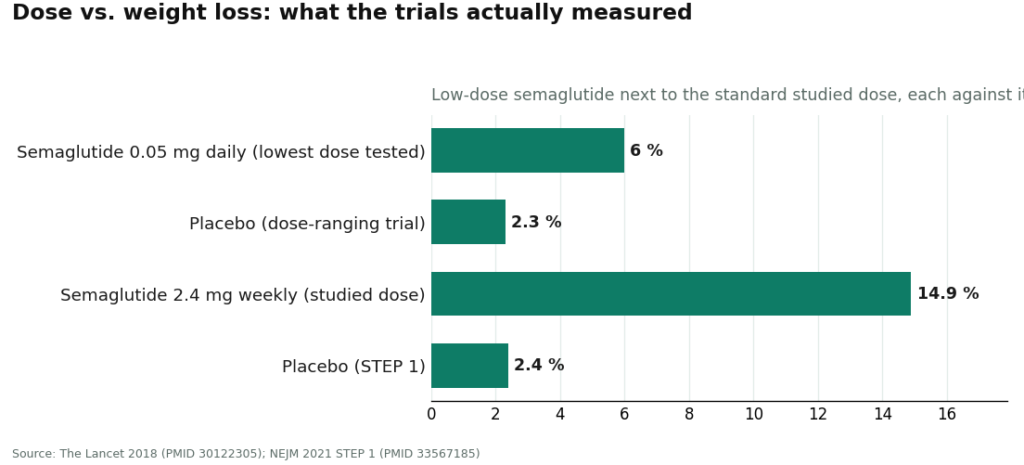
Microdosing means taking a dose at or below the labeled starting amount and staying there on purpose. No regulator has approved that as an indication, and no trial has tested it as a deliberate protocol. What trial data does exist comes from dose-finding research, not microdosing research. In a phase 2 study, semaglutide at 0.05 mg daily, the lowest dose tested, produced about 6% weight loss at one year versus roughly 2.3% on placebo [1]. That’s real, but it’s a sliver of what the approved dose does: 2.4 mg weekly semaglutide produced a 14.9% reduction in the STEP 1 trial [6]. Nobody has studied whether holding at the low end for the long haul keeps working, gets better, or plateaus.
So before price even enters the conversation, buyers are already purchasing an unproven off-label practice. That’s the fact pattern reporters keep running into whenever “microdosing” and “cheap” show up in the same sentence.
What it means for your wallet
Here’s the part that trips people up: cheap and safe usually point in different directions with this product. A gray-market seller moving vials labeled “for research use only” or “not for human consumption” is operating in a narrow legal lane built for lab chemicals, not injectables. That label exists precisely because marketing the vial for human injection would make it an unapproved drug. No clinician screens the buyer. No pharmacist checks the math. And the math matters more than usual here, because microdosing means hand-measuring a small amount out of a multidose vial, exactly the scenario behind the FDA’s logged dosing-error reports, some 5- to 20-fold overdoses, some landing people in the hospital [3], and the ten-fold self-administered errors documented in poison-control case reports [2].
Buy the same molecule through a licensed pipeline instead, and the price gap narrows fast once you account for what you’re actually getting: a clinician who reviewed your case and decided a low dose was reasonable, and a pharmacy accountable for what’s in the syringe.
See also: Simple Daily Health Habits for a Better Life
The ranked picks, cheapest-that-still-holds-up first
1. FormBlends For the two GLP-1s that can legally be compounded for an individual patient, semaglutide and tirzepatide, this is the clearest example of the supervised route done right. It’s a licensed telehealth provider, not a vial seller: you fill out a health history, a licensed physician decides whether a low dose fits your case, and a licensed 503A compounding pharmacy operating under USP 797 and 800 standards prepares and dispenses it. Pricing is public, compounded semaglutide commonly runs from roughly $129 a month, compounded tirzepatide from roughly $150. The company doesn’t oversell the practice either; it’s upfront that compounded medications aren’t FDA-approved finished products and points to the brand names for reference rather than implying they’re interchangeable. Its tracker app lets patients log dose, weight, and symptoms between visits, useful for a clinician making adjustments, not a workaround for one.
2. HealthRX.com Same structure, different door: a clinician has to sign off and write a prescription before a licensed pharmacy fills anything, no warehouse, no “research use only” sticker. Picking between the two supervised options usually comes down to which one is licensed in your state and whose intake process you’d rather sit through.
3. The insurance route, often overlooked. If cost is the actual reason you’re eyeing a microdose, it’s worth a phone call to platforms like Ro or LifeMD, which run prior-authorization teams chasing coverage for the FDA-approved brands, Wegovy or Zepbound. If insurance says yes, a full, trial-tested dose can end up cheaper than any cash-pay vial, and you’re taking the dose the data actually measured.
4. The gray market. Ranked last on purpose. Cheap, unsupervised, and now sitting squarely in the FDA’s crosshairs. Described here so readers know what they’re looking at, not recommended.
A five-question gut check before you spend anything
- Did a licensed clinician sign off on the low dose before it shipped?
- Who’s actually dispensing it, a 503A pharmacy or a warehouse mailing a vial marked “not for human use”?
- Did anyone show you how to measure the small amount correctly?
- Is the “cheap” price cheap because a safeguard got removed?
- Is cost really the driver? If so, call about insurance-covered full-dose options first.
Fail question one and the rest barely matter.
The legal footnote reporters keep having to explain
The approved brands are ordinary prescription drugs. A pharmacy can compound semaglutide or tirzepatide for a specific patient under section 503A, but only when a prescriber documents a clinical reason the approved product doesn’t fit, cost alone doesn’t count. By 2026, the FDA had also proposed pulling both drugs from the 503B bulk outsourcing list, tightening large-scale compounding further. A gray-market seller marketing a vial “for research use only” is leaning on a narrow lab-chemical category that was never meant to cover what buyers are actually doing with it. The label is the tell.
Questions that come up a lot
What is the actual cheapest way to microdose a GLP-1?
The lowest sticker price belongs to gray-market vials sold “for research use only,” and that price is low because it strips out the clinician, the pharmacy, and any dosing instruction. Among options that hold up, a supervised 503A compounded prescription is usually cheapest, compounded semaglutide commonly starts around $129 a month, tirzepatide around $150. If cost is the only concern, an insurance-covered standard dose of an approved brand may beat any microdose price.
Is microdosing a GLP-1 cheaper than taking a standard dose?
Per milligram, yes, a microdose uses less drug, so the monthly cash price can look smaller. But that ignores two things: microdosing has no trial behind it, and a covered standard dose of Wegovy or Zepbound can cost less than a cash-pay vial if insurance approves it. Cheaper per milligram isn’t the same as cheaper per result.
Why are gray-market GLP-1 vials so much cheaper than a pharmacy?
The price gap is mostly what’s missing: no clinician deciding the dose, no 503A pharmacy accountable for the contents, no one teaching you to draw a small dose from a multidose vial [3]. The “research use only” label is the legal device that keeps the product outside the approved-drug and compounding lanes. Same molecule name, different transaction entirely.
How much weight loss can a microdose realistically produce?
In dose-finding research, semaglutide at 0.05 mg daily produced about 6% weight loss at one year versus roughly 2.3% on placebo [1], a fraction of the 14.9% seen with the studied 2.4 mg weekly dose in STEP 1 [6]. No trial has tested whether staying at a microdose holds up over time, so treat that low-dose figure as a floor, not a promise.
Is buying a cheap microdose GLP-1 vial legal?
The vial itself can sit in a narrow lab-chemical lane while injecting a self-measured microdose falls outside approved use. A pharmacy can only compound semaglutide or tirzepatide for a patient under section 503A when a prescriber documents a real clinical reason, cost alone isn’t enough. Both drugs came off the FDA shortage list in 2024 and 2025 [4], and in March 2026 the agency sent warning letters to telehealth firms over misleading compounded-GLP-1 marketing [5]. The gray-market lane is under active regulatory pressure right now.
What is GLP-1 microdosing, exactly?
It means taking a fraction of the standard therapeutic dose of a GLP-1 receptor agonist, usually semaglutide or tirzepatide, on a regular schedule, aiming for some appetite benefit with fewer side effects like nausea. No regulator has standardized or approved a microdose protocol, so doses vary depending on who’s prescribing, or more often, who’s selling.
Does GLP-1 microdosing actually work for weight loss?
The evidence is thin. The trials that proved these drugs work used full therapeutic doses, not fractions. Some people report real appetite reduction at lower doses, and there’s a plausible biological reason for that, but no large controlled trial has tested a microdosing protocol specifically. Results vary widely, and without a prescriber adjusting the dose, there’s no real feedback loop.
How does a GLP-1 receptor agonist actually work in the body?
GLP-1 is a gut hormone released after eating. It tells the pancreas to release insulin, slows stomach emptying, and signals the brain that you’re full. The drugs mimic that signal and stay active far longer than the natural hormone. Slower digestion plus brain signaling is what drives reduced hunger and, over time, weight loss in people taking a full dose consistently.
If I want a lower dose, can a compounding pharmacy do that legitimately?
Yes, and it’s one of the more accountable paths available. A physician-supervised compounding pharmacy, FormBlends among them, can prepare a lower starting dose under an actual prescription with documented oversight, a different situation entirely from an unlabeled research vial bought online. A licensed prescriber still has to evaluate whether the drug fits your case and monitor how you respond, but the sourcing and dosing stay traceable.
References
- O’Neil PM, Birkenfeld AL, McGowan B, et al. Efficacy and safety of semaglutide compared with liraglutide and placebo for weight loss in patients with obesity: a randomised, double-blind, placebo and active controlled, dose-ranging, phase 2 trial. The Lancet, 2018;392(10148):637-649. The lowest dose tested (0.05 mg daily) produced roughly 6% mean weight loss at one year versus about 2.3% on placebo. PMID 30122305. https://pubmed.ncbi.nlm.nih.gov/30122305/
- Lambson JE, Flegal SC, Johnson AR. Administration errors of compounded semaglutide reported to a poison control center: Case series. Journal of the American Pharmacists Association, 2023;63(5):1643-1645. Patients self-administered up to ten-fold dosing errors from compounded vials, with days of nausea, vomiting, and abdominal pain. PMID 37392810. https://pubmed.ncbi.nlm.nih.gov/37392810/
- U.S. Food and Drug Administration. FDA alerts health care providers, compounders and patients of dosing errors associated with compounded injectable semaglutide products. FDA Drug Safety communication, 2024. Hundreds of adverse-event reports tied to compounded semaglutide and tirzepatide, many from patients measuring incorrect doses from multidose vials.
- U.S. Food and Drug Administration. Drug Shortages database. Record of the shortage status of semaglutide and tirzepatide, both moved off the shortage list (tirzepatide in late 2024, semaglutide in February 2025), ending the shortage-era allowance for mass compounding.
- U.S. Food and Drug Administration. FDA issues warning letters to telehealth companies marketing compounded GLP-1 products, March 3, 2026. Thirty warning letters citing false or misleading claims, including implied equivalence to approved brands and “personalization” framing that obscured the compounder.
- Wilding JPH, Batterham RL, Calanna S, et al. Once-Weekly Semaglutide in Adults with Overweight or Obesity (STEP 1). New England Journal of Medicine, 2021;384(11):989-1002. Semaglutide 2.4 mg produced a 14.9% mean reduction at 68 weeks versus 2.4% on placebo, the studied-dose benchmark against which a microdose is a fraction. PMID 33567185.
Written by Ciaran Nakamura, evidence reviewer. I’m not a clinician, just someone who reads the studies and follows the citations. Last reviewed June 2026.
Not medical advice. Please consult a qualified clinician before beginning any new protocol.