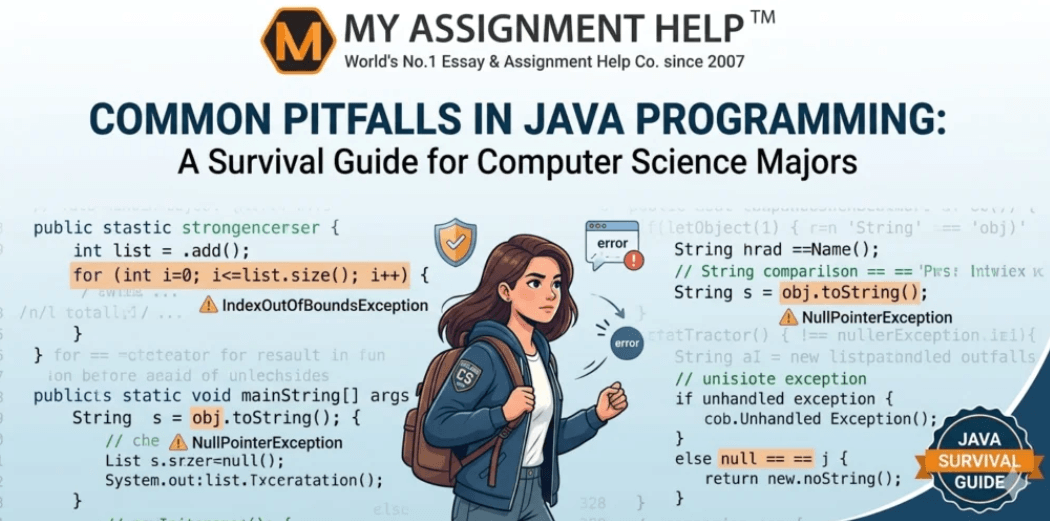
Common Pitfalls in Java Programming: A Survival Guide for Computer Science Majors

For Computer Science majors, Java is often the first “serious” encounter with the complexities of object-oriented programming (OOP). While its “Write Once, Run Anywhere” (WORA) philosophy makes it a cornerstone of modern software engineering—powering everything from Android apps to high-frequency trading systems—it is also a minefield of subtle logic errors and memory management nuances.
Mastering Java requires more than just learning syntax; it requires navigating the architectural traps that lead to “spaghetti code” or fatal runtime exceptions. This survival guide breaks down the most frequent mistakes made by students and provides a data-driven roadmap to writing cleaner, more efficient code.
The Landscape of Java Development in 2026
Java remains a dominant force in the industry. According to the 2026 TIOBE Index and recent developer surveys, Java consistently ranks in the top three most used languages for enterprise-level applications. However, for students, the transition from basic logic to enterprise standards involves a steep learning curve that often requires professional online assignment help to navigate regional academic standards effectively.
1. The NullPointerException (NPE): The Billion-Dollar Mistake
The NullPointerException is perhaps the most infamous error in Java. It occurs when an application attempts to use an object reference that has not been initialized.
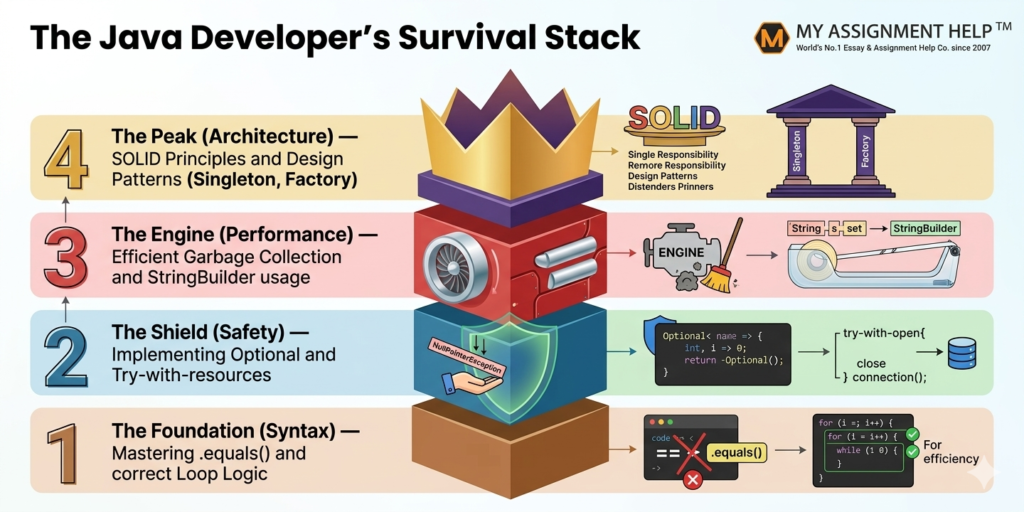
When tackling high-stakes university projects, many students turn to specialized platforms like myassignmenthelp for reliable java homework help to ensure their code is not only functional but follows the robust error-handling protocols required in professional environments. Using the Optional class introduced in Java 8 is a primary “survival tactic” here; instead of returning a null object, return an Optional<T> to force the caller to acknowledge the possibility of an empty value.
2. Misunderstanding Memory Management: Memory Leaks in Java
While Java’s Garbage Collector (GC) automates memory management, it is not infallible. A “memory leak” in Java occurs when objects are no longer being used but are still referenced by active parts of the program, preventing the GC from reclaiming the space.
- The Pitfall: Keeping static references to large objects or failing to close resources like database connections (java.sql.Connection) or file streams.
- The Survival Tactic: Always use the try-with-resources statement. This ensures that each resource is closed at the end of the statement, preventing leaks and keeping the Heap memory healthy.
3. Comparing Objects with == vs. .equals()
This is a classic trap for those transitioning from languages like C++ or Python.
- The Pitfall: Using == to compare the content of two Strings. In Java, == checks for referential equality (do these two variables point to the exact same memory address?), while .equals() checks for value equality.
- The Survival Tactic: Always use the .equals() method for object comparisons, especially with Strings and wrapper classes like Integer.
4. The “God Class” and Ignoring SOLID Principles
Computer Science assignments often lead students to create one massive class that handles everything—input, logic, storage, and output.
- The Pitfall: Violating the Single Responsibility Principle (SRP). Large classes are difficult to debug, impossible to test, and break the core tenets of OOP.
- The Survival Tactic: Break code into smaller, modular classes. Aim for high cohesion and low coupling. If a class has more than 300 lines of code, it’s likely time to refactor.
5. Improper Exception Handling
- The Pitfall: Using a “catch-all” block like catch (Exception e) {}. This is known as “swallowing” an exception. It hides the root cause of bugs, making it nearly impossible to diagnose why a program failed.
- The Survival Tactic: Catch specific exceptions (e.g., FileNotFoundException) and provide a meaningful recovery path or log the error using a standard logging framework like Log4j2 or SLF4J.
Key Takeaways for CS Majors
- Prioritize Readability: Code is read more often than it is written. Use meaningful variable names.
- Embrace Modern Java: Don’t stick to Java 7 patterns; use Streams, Lambdas, and the java.time API.
- Test Early: Write Unit Tests (JUnit) for every logic module you build to ensure reliability.
- Resource Management: Always close your streams. A program that leaks memory is a failing program.
Frequently Asked Questions (FAQ)
Q: Why is Java still taught in universities if newer languages exist?
A: Java’s strict type system and OOP enforcement provide a foundational understanding of software architecture that translates well to almost every other backend language.
Q: Is String a primitive type in Java?
A: No, String is an object. This is why you must use .equals() for comparison rather than ==.
Q: How can I avoid the “Heap Space” error?
A: This usually results from infinite loops adding items to a collection or memory leaks. Use a profiler like VisualVM to track object allocation.
Q: What is the best way to handle multithreading in Java?
A: Avoid manual Thread management. Use the java.util.concurrent package, specifically ExecutorService, for more robust and scalable concurrency.
See also: Incident Response Planning
Author Profile: Sarah Jenkins
Senior Academic Consultant at MyAssignmentHelp
Sarah Jenkins is a veteran software engineer and senior academic consultant with over 12 years of experience in Java Enterprise Edition (JEE) and distributed systems. Holding a Master’s degree in Computer Science from the University of Melbourne, she has spent the last decade mentoring students in mastering the nuances of robust software design.
At myassignmenthelp, Sarah specializes in helping students navigate complex programming paradigms, ensuring their work meets the rigorous E-E-A-T standards required by top-tier universities.
References & Data Sources:
- Oracle Java Documentation: Standard Library and Best Practices (2026).
- TIOBE Index (2026): Language Popularity and Industry Demand Trends.
- JetBrains Developer Ecosystem Report: Common Java Errors and Tool Usage Statistics.
- IEEE Software: Research on the impact of technical debt and code “smells” in student projects.